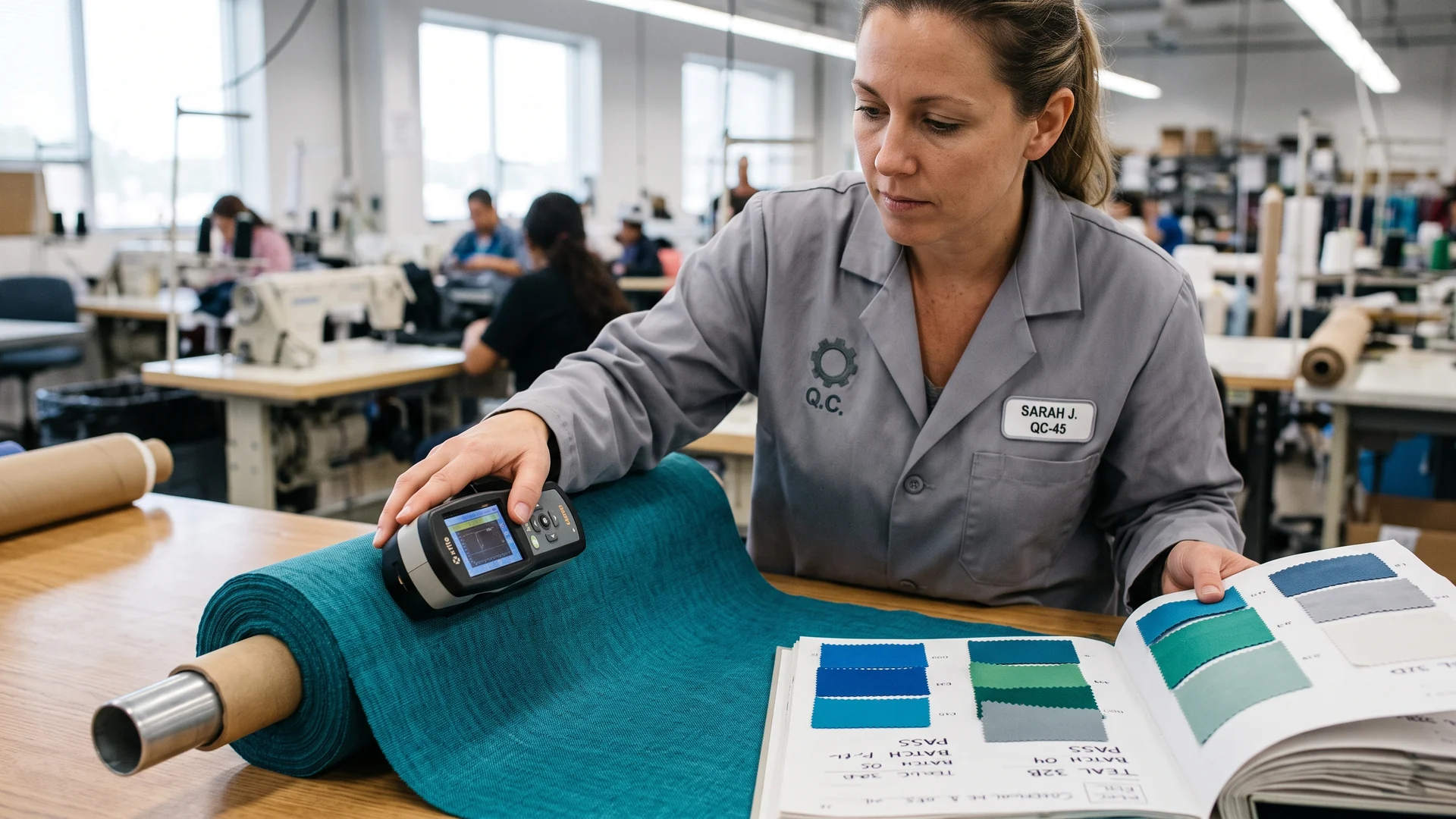
Staff uniforms rarely fail on the first order. They fail on the third re-order, when new hires on a ward or a hotel floor stand next to colleagues whose tunics came from an earlier batch, and the two blues no longer match. This article walks through how that drift is stopped at the factory, step by step, and which records should arrive with every re-order.
Why re-order colours drift
Every fabric order is dyed in a new dye lot. Dye chemistry, water, fibre batch and machine load shift a little each time, so two lots dyed to the same recipe can land visibly apart. Most suppliers approve the new lot by eye, under store lighting, against a faded swatch. The result passes inspection and fails in the staff room.
The fix is not a better eye. It is a fixed physical reference, a number measured against it, and a written rule about what happens when the number is wrong.
One retained lab dip per approved colour
When a colour is approved, the lab dip signed off becomes the program's master reference. It is kept in the factory's retained lab-dip library, and the buyer keeps a twin of it. From that point on, every re-order of that colour is judged against the retained dip: not against the last batch, and not against anyone's memory.
- One reference per colour. A hospital group running scrubs in 5 department colours across 11 facilities holds five retained lab dips, one for each colour.
- A twin in your hands. The buyer's copy makes it possible to check any delivery side by side, without asking the factory.
- Fabric on reserve. Core colours of an active program are held in reserve for re-orders for 24 months, so many re-orders are cut from fabric that has already been measured.

ΔE ≤ 1.0, measured on fabric before cutting
ΔE (delta E) is a single number for how far one colour sits from another. The colour lab reads every re-order fabric roll batch with a spectrophotometer under D65 daylight with a 10° observer, using the CIE ΔE2000 formula, and compares it with the retained lab dip. The tolerance is ΔE ≤ 1.0, tight enough that two garments hung side by side read as one colour.
- ΔE ≤ 1.0
- Tolerance against the retained lab dip
- D65 · 10°
- Daylight and observer used for every reading
- 24 months
- Core-colour fabric reserve for active programs
The timing matters as much as the number. The reading is taken on the fabric, before a single panel is cut. Once fabric is cut and sewn, an off-shade batch can only be scrapped or shipped. Before cutting, it can still be corrected.
| Step | Who | When | What you receive |
|---|---|---|---|
| Pull the retained lab dip | Colour lab technician | Re-order confirmed | The colour reference named on the order |
| Read each roll batch | Colour lab technician | Before release to cutting | ΔE2000 reading against your retained dip |
| Release or hold | Colour lab technician | Before cutting | Notice before cutting if the ship date moves |
| Cut from the same file | Pattern room lead | Cutting | Same CAD pattern and marker as the first run |
| Label every carton | Packing line | Packing | PO, style, colour and dye lot on the label |
When a roll reads outside tolerance
A reading outside ΔE ≤ 1.0 does not go to cutting. The fabric is held back and re-dyed or replaced. If that moves the ship date, the buyer is told before cutting, not after the cartons are packed. The operating rule is written down: when the date and the colour conflict, colour wins.

The rule
Out-of-tolerance fabric never goes to cutting to save a date. Any change to the ship date is reported before cutting starts.
Records that travel with every re-order
Colour control is only useful if the buyer can check it. Three records tie each delivery back to the reference that was approved:
- The spectrophotometer reading against the retained lab dip ships with every re-order.
- The dye lot is printed on every carton label with PO, style and colour, plus the employee name, size and site for pack-by-person rollouts.
- The dye-lot record is kept against the retained lab dip, so any later re-order can be traced to the batch it must match.
Re-orders of the same spec take 15–20 days and are cut from the same CAD pattern and marker files as the first run, so fit stays as constant as colour. If a batch still arrives off, report it within 30 days of receipt with photos or pieces; pieces confirmed defective against the approved sample are remade or replaced at the factory's cost.
Five questions to ask before your next re-order
Whoever makes your uniforms, these questions show whether re-order colour is controlled or hoped for:
- What physical reference is my colour judged against, and do I hold a copy of it?
- What tolerance is used, and measured how: instrument, light source, formula?
- Is the reading taken on fabric before cutting, or on finished garments?
- What happens to fabric that fails, and when will I hear about it?
- Which record on the carton links my delivery to a dye lot?
If the answers are "by eye", "after sewing" or "we will let you know", the drift will show up on your staff. To see where the colour lab sits in the factory, read about the uniform factory and its colour lab. For product ranges and program options, start at the custom uniform manufacturer home page, or browse more buyer guides on the uniform blog.